OKRs are not OK
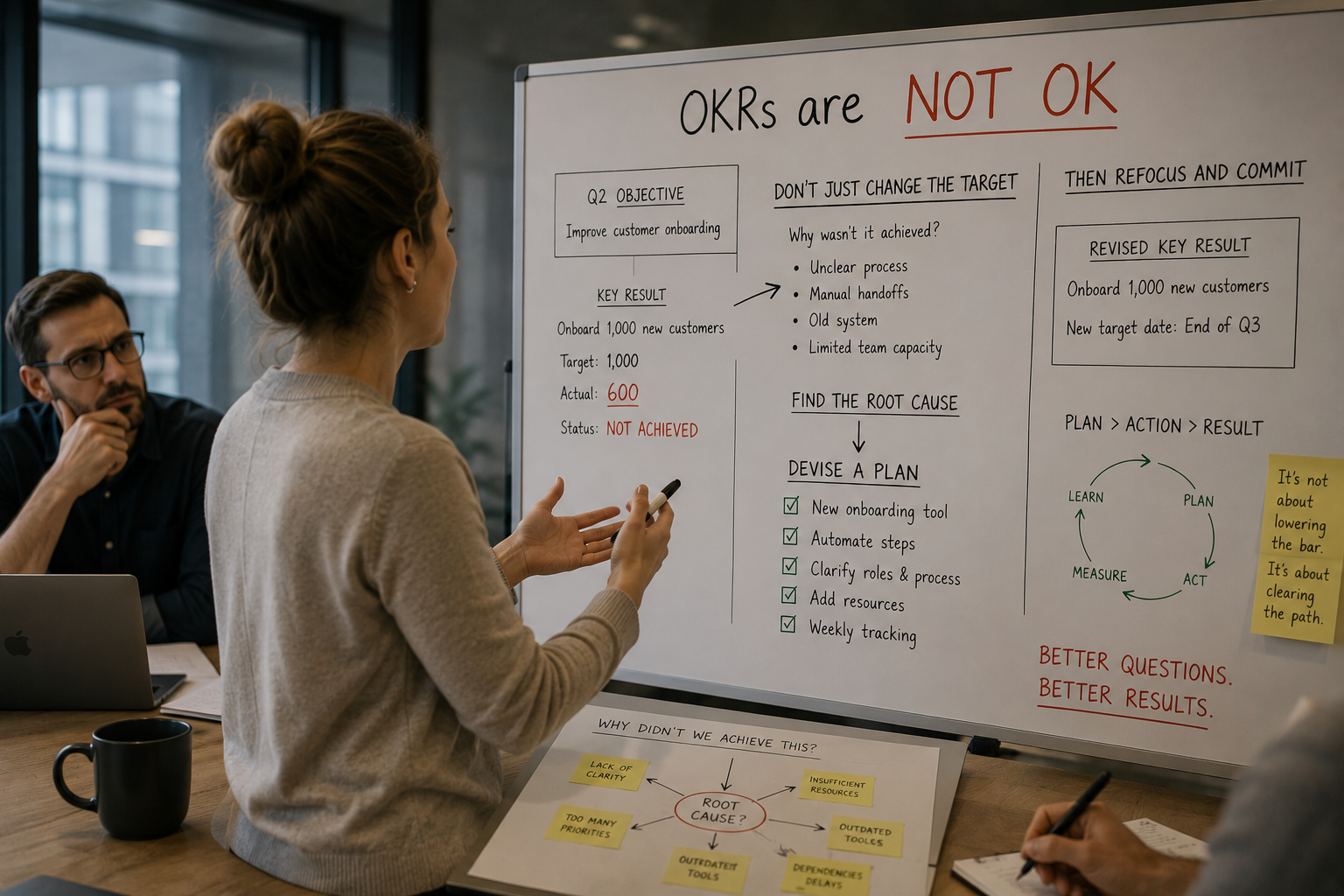
More and more companies are adopting OKRs (Objectives and Key Results) to connect strategy with operations. And it makes sense: they create clarity, shared direction, and measurable targets. But OKRs alone are not enough. Because it’s entirely possible to define the “perfect” OKRs and still fail at strategy implementation.

I recently heard the strategy director of a large Nordic company explain how they’ve implemented OKRs across the entire organization, and how it has helped leadership:
- prioritize and focus on what matters most
- create a shared direction and understanding of what needs to be achieved
- ensure everyone pulls in the same direction
- maintain regular progress reviews
- and continuously adjust OKRs when they see they may not be able to deliver on them
Very good. Very sensible. But let’s make one thing crystal clear:
You don’t succeed with strategy execution just because you have clear OKRs.
And the point is not to simply revise OKRs downwards when you fail to meet them. That misses the point entirely. OKRs are a useful framework. But that doesn’t mean the organisation is capable of delivering or that action points will actually become action.
So when OKRs are consistently lowered every time targets aren’t met, you have to ask: Have we really done enough to help people succeed? Have we truly set them up to be able to deliver?
Strategy execution is not about setting goals. It’s about making it possible for the organization to achieve them.
OKRs shouldn’t just measure performance; they should trigger support. They shouldn’t only state what needs to happen, but drive how it becomes possible.
That means:
- Leadership must be honest about the organization’s delivery capacity.
- Support must be built around teams, not just expectations.
- And leadership must talk as much about the conditions for performance as the goals themselves.
People need help to succeed. They need structure, prioritization, support, and room to learn.
So next time you set OKRs:
Don’t just ask what you want to achieve, ask how you will help people get there.
Only then are OKRs truly OK. Otherwise, it’s just theatre.
At Ahead Group Consulting, we’ve developed the Implementation Capacity Index, a framework that helps leaders understand how capable their organization really is of executing, before setting targets and ambitions that never leave the PowerPoint deck.
The ability to execute depends on three things: Culture, resources, and structure — and how strong and functional they are.
When strategies die on paper, it’s usually because ambition isn’t grounded in the organization’s reality. With our approach, clients can identify and resolve organizational barriers before they stop ambition.